Friday, April 5, 2013

Day 3 - A Personal Touch

Today I chose to be part of a smaller group of 7 that was headed to the Salvation Army in Seaside Heights, New Jersey. The other 46 people in our group helped with the Bucket Brigade and installing linoleum in a house.

From my end, we arrived at 9 a.m. at the Salvation Army and had an hour to learn the ropes before the facility officially opened to the public at 10 a.m. The Salvation Army had three lines of tables. The first line included women’s winter gloves, children’s slippers (with a Star Wars Darth Vader head), water resistant boots and racks of men’s and women’s clothes. The middle line was stacked with different food items, from canned green beans and corn to peanut butter, jam, soup, canned tuna and bags of cereal, to name a few. The final line of tables were stacked with hygiene products, such as toilet paper, soap, baby wipes (which can double as wet wipes), toothpaste and cleaning supply buckets. A couple tables toward the back also had blankets and hand towels.


Two girls from Elyria Catholic High School in Elyria, Ohio unload a box of waterproof boots. (Photography by Rachel Wittrock) 

Most of the people I helped choose items (they stressed to not use the word shop, that word can have a connotation to it and many have nothing, no homes, no jobs, no money) had been at the Salvation Army before. However, I did help one man who did not know about the Salvation Army before and yesterday was his first time there. I definitely helped him grab more items than anyone else I had today. In addition to him and his wife, he has four children. There were times when he would turn to me and ask me how many can I have, just one? My response was go ahead and take whatever you need, then reminded him that he can come back every seven days. But so many of these people have very little, so I had no problem giving him two 24-packs of water bottles, numerous cans of corn, mac and cheese, coffee, etc. And the Salvation Army said told us they could take what they want.
 
I helped a few people right away in the morning, but then two trucks arrived stocked with supplies. Since I am young, energetic and fairly strong, I opted to let some of the other people help up front while I unloaded the truck. I helped fill at least a half dozen carts with packs of water bottles, hand sanitizer, toilet paper, etc. At one point I filled a cart with water bottles packs, 24 bottles to a pack. We filled the cart six packs across and four tall. When the cart was filled, I wheeled it in the building all by myself and unloaded the whole cart, also by myself. I was joking around, with all the packing and unpacking of items, saying I’m going to be so buff by the time I get home, lol. Things really picked up in later morning, and I was unable to break until 1:30 p.m., when my stomach was mirroring Audrey II from Little Shop of Horrors, screaming “Feed Me!”

After lunch I returned and spent the rest of the time stocking items as they were taken and helping people pick up the items they needed. I have to admit, I managed to stay composed, but some of the stories were very hard. When Katrina hit it was a media frenzy, tons of coverage, the volunteer efforts. But out here, volunteer efforts are focused on main tourism areas, and I wish I could say the stories of people not getting what they deserve are once in a while, but that is not just the case.


Two trucks filled with supplies for the Salvation Army, including toilet paper, hand soap, chicken alfredo individual meals, tote bags for children and packages of 24 packs of bottled water. The bottled water was a God-send for people, considering we actually ran out of it that morning.
This morning I spoke with a woman, Sandra Bauman, who lost pretty much everything. Her house took on five feet of water and the foundation of her house was split right down the middle, she said her house is bowed and she lost more than $70,000 worth of equipment that was in her house. The township declared her house unlivable, condemned and she has to demolish it. The insurance is another story completely. She said an insurance claims investigator came out to the sight, saw the crack in the foundation down the middle. And he actually had the audacity to tell her that her house is not unlivable, and that she should just pour concrete down the crack, that will be fine. The insurance company gave her $30,000....$30,000 and her house was insured for $165,000. What makes it worse is she cannot apply for additional aid from FEMA because FEMA will only reimburse for up to $30,000, and she already received that in insurance. Some of my fellow volunteers who worked there the past two days shared similar stories. One of those stories was about a man who lost everything: his house and his property and belongings in Hurricane Sandy, and both his wife and son died in the months since.

However, I also met the most amazing man at the Salvation Army today. ??? owned a lot of non-commercial property on the ? island, he said approximately $2 million worth of land. When Hurricane Sandy hit, he lost pretty much all of that. Can you imagine? A major storm hits and you take a $2 million loss. He has not been reimbursed for any of that. If that was me, I think I would be so overwhelmed by a sense of loss, I don’t know what I would do. Yet instead of cursing God or Mother Nature or the government, he has faith. Don’t get me wrong, he was frustrated with the way government works, but when I asked him how he was going to recover, he goes “I’ll be fine.” He said he has been helping other people that suffered in Hurricane Sandy and he has also received help from other people. He is trusting that with help, he will be able to recover.

What I found interesting is Hurricane Sandy was not the first major hurricane he went through. Most of the people I talked to said they were not prepared for anything like Hurricane Sandy to occur, and that the last major hurricane in the area occurred a little more than 50 years ago, in 1962. Well ? was 12 years old at the time when the 1962 hurricane hit. Ironically he said going through the first hurricane taught him things, and he was better prepared for Sandy last October. Again, for someone who lost so much, I was just amazed at the positive attitude he had. It was a breath of fresh air.


Our volunteer group at the Salvation Army on Thursday, April 4. Between unloading two trucks full of donated items, sorting and stocking the items and helping the day’s visitors, there wasn’t an idle moment. 

We talked about other things as well, and at one point he told me that I should always reach beyond, reach for the big goals and to never let others discourage me. I told him that is how I normally am, and whenever someone tries to get me down or tell me I will never accomplish my goals, I fight tooth and nail to prove them wrong, and as a result I usually succeed. Apparently my attitude brightened his day, and as I helped him load his bags of groceries into his car, he told me that it was a pleasure meeting me, that I brightened his day and he would be in a good mood for probably a month.

The Salvation Army closed for the day at 4 p.m., and while we were waiting for the bus to pick us up in 40 minutes, we decided to take a stroll about a half mile away and check out the house that the Jersey Shore cast resided in. I settled for just checking out the outside of the house - you could tour the inside for $10, but honestly, the show irritated me and I never watched it, so I did not feel like going in. Outside the house an organization was actually selling clothes - sweatshirts, T-shirts, sweatpants, and some accessories, sunglasses, coffee mugs, slippers, to benefit the people affected by Hurricane Sandy. I purchased a black sweatshirt for $25, with the words Restore the Shore printed on it. Most of our group members purchased something, knowing that pretty much all the funds would go back to helping the victims.


Although I do not watch Jersey Shore I did decide to check out the house while I was there, especially since it was only 10 minutes walking from where I volunteered. (Photography by Rachel Wittrock)
 
Tomorrow will be our last full day in New Jersey. The National Relief Network did plan a fun day for us - they say whenever they take a group somewhere they build in a fun day so the volunteers can see something besides just devastation, they want to share some of the good in the area. So....tomorrow we will be traveling to Hoboken and meeting up with....the Cake Boss! Not gonna lie, a part of me would honestly prefer to go somewhere else and help with more disaster relief (and I am not the only one on the trip who would like to do that), but tomorrow should be pretty fun. My last blog post from the trip will be posted early Saturday morning. We will depart at 6 a.m. Saturday morning and return to Sun Prairie close to midnight.

A part of me can’t believe this trip is almost over. I’ve been looking forward to it since I first heard about it in January, and the time flew by so fast. However, I also feel a sense of accomplishment. I was definitely not wasting time or lazing about, I put in a solid 7 hours of work every day, and even doing somewhat heavy lifting at times. So while I wish I could stay longer and help, I will return with a sense of accomplishment and happiness that I made a difference in the lives of other people. For some of the people at the Salvation Army today, just listening made a world of difference.


A roller coaster on the Seaside Heights shore, still submerged in water. Again, I was naughty and wandered beyond the Police Do Not Cross yellow tape, only this time I got busted. Oops. At least it was after I got the shot. (Photography by Rachel Wittrock)

Thursday, April 4, 2013

Day 2: Cleanup continues

After staying up until 2 a.m. Wednesday morning, my day began at 6:30 a.m., all bright and blurry-eyed. After a quick shower, I headed to the dining hall for some breakfast, courtesy of the National Relief Network. After breakfast 10 of our group members headed over to the Salvation Army to assist with helping the survivors find what they need and listen to their stories. The rest of us, myself included, headed back to Little Egg Harbor to continue our cleanup efforts. I must admit, the area today wasn’t too bad. Don’t get me wrong, certain areas were pretty trashed, lots of wood, doors, even an air conditioner. There were also tons of bottles, bags, styrofoam, even a few tennis balls. Another one of our group members also discovered the handlebars to a bicycle, but no bike. We did find a single pedal and bar from a bike though. 


Piling some wood beams and a garbage bag full of bottles and other trash onto one of the piles our group assembled during clean up at Little Egg Harbor.  

There was a lot more work in the morning, a lot more piles. At noon we too a break for lunch, and continued with the cleanup again later. However, once we crossed the bridge there was some cleanup to do, but within maybe 45 minutes there was nothing, no trash. We assumed that because the area was wide open that any debris that was there just got washed further down. The main areas where there was a lot of junk were areas with trees, which probably trapped the debris. Still, we managed to make a sizeable dent.


Elyria Catholic High School boys lug some of the heavier debris up a small hill and lift it over the guardrail to put by the side of the road. Thank God for those high school boys, they dominated removing the major/heavy debris. (Photography by Rachel Wittrock)
 
Even though the area was not as bad as other places, we still made a difference. Every piece of trash that we picked up, all the major wooden and metal objects that the Elyria Catholic High School boys lugged up, is something less that the locals or other relief groups have to do. Plus, the areas that were majorly affected like Breezy Point and Hoboken are the areas that are getting a lot of attention, a lot of aid. Smaller areas like Little Egg Harbor do not get as much attention, the devastation may not be as severe as other areas, but that does not mean the work is any less important. So while we may not be in an area that is completely and totally devastated, we are working in an area that otherwise might not be a priority to other groups.

Towards the end of the day, we were greeted by a special visitor: Little Egg Harbor Mayor John Kehm. The mayor, along with a couple of his administrators, took the time to come out and thank us, and to tell us just how much our help means to them, and how much they were affected by Hurricane Sandy. That visit was a complete surprise to me. While none of us on the trip are here for recognition - we are here because we want to help others - it was really neat to have the mayor stop by and speak to our group.


Trust me...I'm a reporter: Little Egg Harbor Mayor John Kehm stopped by say thank you to our group, and got a kick out of my hat.

The rest of my group introduced me to Kehm and told him that I was documenting our trip and would be writing an article for the Sun Prairie newspaper, The Star. Then they told him about the hat I was wearing all day, which EVERYONE got a kick out of. The hat in question was given to me by my boss a few months ago, which he picked up at the Newseum. It is a black cap, and across the front, written in white, are the words “Trust me....I’m a reporter.” When I donned it again, Kehm got a kick out of it and started laughing, and we had to get a photo together.

We then departed Little Egg Harbor and headed over to Seaside Heights. I have to admit, that was much harder to see. Seaside Heights was hit pretty hard. By the ocean’s edge are huge sand piles, I’d have to say probably 10 feet tall. That was not there before Hurricane Sandy hit. As a matter of fact, that area used to be the Boardwalk. While some houses in the city were just fine, others were abandoned and beyond repair.


No, I did not take the photo crooked. The above house in Seaside Heights, N.J. was hit hard by Hurricane Sandy. In addition to pretty much having a side of the house destroyed, the foundation was damaged, tilting the house sideways. (Photography by Rachel Wittrock)

More than a few houses were knocked off their foundation and slanting on one side. Still others had sides missing from their house, or sides completely knocked in and reduced to piles of wood. CDs, alarm clocks, DVDs, and the rest of the contents of houses were scattered all around. But one of the hardest things for me was the American flag by one of the last houses before the beach. Despite the storm and the raging winds that Hurricane Sandy wrought, the flagpole was still standing. A portion of the flag was gone, the tattered remains flapping in the breeze.

It was hard to see that flag tattered and torn, because it is a symbol of our great country. But at the same time, it also symbolized the strength of our country, and of our people. Winds in excess of 60 miles per hour raged, trees were uprooted, houses destroyed, lives lost. Yet that flag stayed rooted. It might have been tattered and torn, worn out, but it survived, it remained standing. While our country and community might be worn out and devastated, the strength of our people remains, the strength of our country is what keeps us able to weather any storm, face any tragedy, with determination.


Despite winds in excess of 60 miles per hour and damaging rain, this American flag, taken in one of the more seriously damaged areas in Seaside Heights, survived. While tattered and torn, I view it as a symbol of the strength of the United States and the American people. (Photography by Rachel Wittrock)
 
Tomorrow I will be heading over to the Salvation Army to help those affected by the storm, to hear their stories and provide a strong shoulder. The rest of the group will be heading somewhere different to help with a bucket brigade and put linoleum flooring in a house. While a part of me wishes I could do that with them as well, I would rather spend time getting the human interaction, the people that went through this firsthand, just providing the listening ear so many need.

It is easy to help clean up an area, easy to quantify a natural disaster into dollars of damage and lives lost, but sometimes we forget the human interaction. For those of us not affected, it is houses destroyed and debris, but for the people that survived, it is the total loss of everything, their homes, their land, and it can be devastating. As a journalist, I have a duty to share those stories, to make the public understand the real emotions and lives behind the tragedy, to put a human face to it. And to let those affected know that they are not forgotten, they continue to be in our hearts.

Photo taken from atop one of the large sand dunes by the beach in Seaside Heights. Shh, don’t tell the cops, but we were definitely not supposed to be there. The whole beach area was beyond the blockade. Sometimes as a reporter you have to take risks. (Photography by Rachel Wittrock)

To see more photos from Wednesday's cleanup, click here.

Tuesday, April 2, 2013

Hurricane Sandy Mission Trip - Day 1: The Cleanup Begins

OK, technically it is Day 2 of our trip, but our first day was 16 hours on a coach bus, so I’m not really counting that.
 
Anyway, we did get to sleep in a little later today due to the fact we rolled into camp at midnight and didn’t really get settled in until 1 a.m. Breakfast was served at 8 a.m., and we were able to make a sandwich and grab some fruit and a granola bar for lunch.
 
The rest of our morning was spent raking leaves at Pinelands Camp. Leaves, leaves everywhere. Even though it is in the woods, the woman in charge pointed out that it is a camp and they do try to keep the grounds clean.
 
The raking crew: After 2.5 hours of raking, the grounds at Pinelands Camp were nice and clear and ready for campers.

Apparently the camp was also affected by Hurricane Sandy last fall. The storm swept through the area and took out the camp’s generator within an hour.
The raking passed by pretty quickly, and with 47 people, our group made quick work of the area.
 
After lunch, we boarded our coach bus and traveled about 45 minutes to Little Egg Harbor, N.J. When Hurricane Sandy hit, the area was under between three and four feet of water. Based on some of the stuff that washed up, it is easy to believe.
 
Some of the items that washed up include: a boat, part of a roof, a dock, dozens of beer bottles, a coconut (yes, I actually found a coconut), a golf ball, cinder blocks, a large metal jug, styrofoam, part of a metal crate, probably for catching some kind of marine life, tons of wood and various other little. We spent about 2.5 hours picking up debris along a road. During that time we managed to clean both sides of the road about 7 feet out, for a half-mile. Not bad for a few hours work. We managed to fill dozens of trash bags with all the debris. If you stacked them all together, it would probably fill a space 6 feet long, 6 feet wide and 5 feet high, but that is just an estimate. 


Among the debris washed up by Hurricane Sandy was a roof, bottles, a coconut, and yes, even a boat. (Photography by Rachel Wittrock)

There was a man with a professional video camera, Kirk Jarvis, with us at the cleanup site as well. At first I thought he was a TV reporter, but it turns out he is actually putting together a documentary about the cleanup efforts that are going on. The project, titled Both Sides of Sandy, should be completed by the end of the summer. For more information, visit www.bothsidesofsandy.com.
 
After the cleanup we did get to witness some of the more profound devastation. We visited the city of Tuckerton, and I was humbled by the scene. According to our guide, 5,000 people were evacuated from their homes, and of those homes, 800 were condemned. The remaining houses have to be raised on wood poles 14 feet above the ground, which can cost the homeowner between $30,000 and $50,000. Apparently FEMA will reimburse the cost, but the homeowner has to pay up front. It really makes you grateful for what you have. Living in the Midwest, we do worry about blizzards and tornadoes, but the chances of a natural disaster wiping through our area and causing that kind of devastation is slim to none. No hurricanes or tsunamis, earthquakes or volcanoes. Negative temperatures in the winter seem a small price to pay for the relative security living in the Midwest grants us. 

Hurricane Sandy forced 5,000 Tuckerton, N.J. families out of their homes, and of those, 800 houses were declared condemned. The houses that are deemed still livable must be raised 14 feet above ground. (Photography by Rachel Wittrock)
I must admit, it does feel good to be a part of helping a community heal. Tomorrow it sounds like we will be returning to Little Egg Harbor to assist with more Hurricane Sandy cleanup, and on Thursday I have committed to go to the local Salvation Army. Apparently they need volunteers to help check people in, stack supplies and help the people that come select what items they need. 
According to a small group that went today, the Salvation Army is providing counseling to people affected by Hurricane Sandy, as well as supplies: toilet paper, toothpaste, food, diapers, cleaning supplies, water, whatever they need. The first time people come they can choose to participate in counseling, and at the end of the counseling they also receive a $50 gift card for each person in their family. So if there is a mother, father and two children, they would receive four $50 gift cards, for a total of $200.
 
The group of six that went today recounted some of the stories of people that received services. Apparently there was one more who lost everything, his house and possessions, and then sadly, his wife died shortly afterwards, leaving him all alone. Another woman was so relieved when she heard about the counseling being offered, she didn’t really care about the gift card, she was just at her wit’s end and needed someone to talk to.
 
Yet another person, a college student by the name of Christian, said he was grateful for Hurricane Sandy. Although his home was destroyed, he said his family came together to help rebuild, and it actually made them closer as a family. As horrible as Hurricane Sandy, it is nice to hear some of the good that came out of the tragedy.
 
Our day concluded with dinner back at the camp and a little group bonding and card game. Everything is going well, and I can’t wait to continue helping with the cleanup from Hurricane Sandy again tomorrow. To see photos from the day's events click here.
 
I’ll be posting a blog every night we are here through Friday, so stay tuned for the next part of this amazing journey... 

Today's debris cleanup crew, which consists of volunteers from a Christian high school in Ohio, and 10 of the 16 members of our Sun Prairie group.

Thursday, January 24, 2013

Battle on the homefront

Whenever there is a conflict and the Commander-in-Chief (the current President) deems it necessary, the men and women in our armed services rise to the challenge, taking up arms to defend our country. And while we think of the sacrifices that they make to secure our freedoms, we don’t always think of the sacrifices that have to be made by those left behind: their husbands, wives, parents, children. The burden can fall heaviest on spouses and children, as a deployment means the spouse has to pick up the slack around the house, serving as cook, handyman and primary caregiver.
 
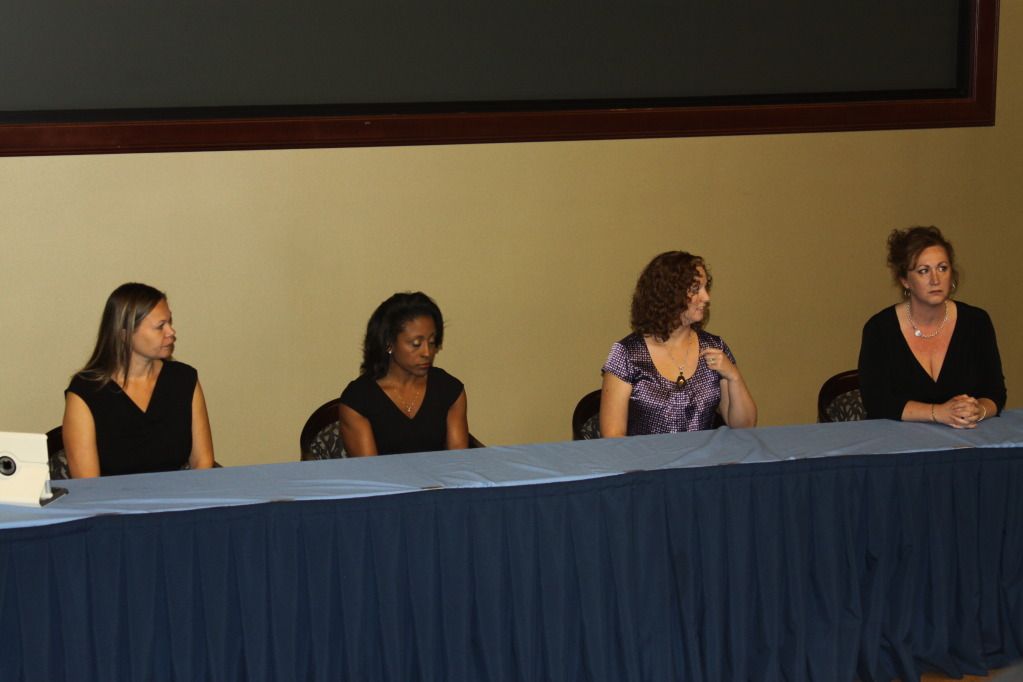
During the Media and the Military workshop, held at Fort Leavenworth and Fort Leonard Wood from Sept. 23-28, I had the opportunity to hear from four military wives - Michele Sumter, Mary Shaver, Denise Fox and Lissa Wojtkun.
 
While all four women are similar in aspect that all have a husband in the military, the way they deal with deployments and constant moves could not be more different.
 
Shaver’s husband is Virginia National Guard Major James Shaver, and she has been a part of the military family for nine years. They have four children together, ranging in age from 2 to 22.
Mary’s husband has deployed twice during their marriage - once to Afghanistan and once to Iraq - for 12 months at a time.
 
“You really learn how to be resilient, being part of the military life you have to be resilient,” Mary said. “...You become everyone: you become mother, you are still wife, you become the handyman, you become the gardener - all those things that my spouse did while he was here, once he is deployed I become all of those people.
 
“It really gives you a sense of pride to know hey, I can do this on my own now,” she continued. “You become resilient, which I think helps not only in the military life, but it also helps you in your day to day life, whether you have a career or other experiences outside of the home.”
 
On the other hand, Michele relies on her family for support when her husband, Major Shawn Sumter, is deployed. Shawn has served three tours in Iraq, all for 12 months or more at a time.
 
When he is home, Michele said Shawn manages the money and helps with cooking and cleaning. Because she has a demanding career as well, Michele said both her and Shawn’s mother visit every other weekend to help around the house.
 

When Michele arrived at Fort Leavenworth, it was the first time she did not have a 9-5 job lined up. Before moving to Fort Leavenworth, Michele was a school principle in Virginia. Even though she has moved, she still works as a consultant for the school, via phone and online. So also spends her time taking courses the fort makes available to military spouses, such as Total Fitness.


From left to right, military wives Mary Shaver, Michele Sumter, Lissa Wojtkun and Denise Fox spoke to journalists from around the world at the Media and the Military workshop at Fort Leavenworth on Friday, Sept. 28, 2012.

When Lissa got engaged to Major Karl Wojtkun, the two of them preplanned for their marriage. Military life wasn’t new to Lissa, whose dad was in the United States Army. However, the two agreed that while Karl was in the Army, Lissa was not going to have a full-time career. Instead, she would take over as breadwinner after Karl put in his 20 years for retirement.
 
“My opportunities when we go to the different bases, and we’ve been to quite a few of them, is that I can jump in as a volunteer and support not just my husband, but the entire base,” Lissa said.
 
During a deployment, some, such as Denise Fox, the wife of Lt. Col. Matthew Fox, choose not to watch the news. She said knowing something bad has occurred overseas can be terrifying, especially when she has not received news.
 
“When you don’t hear from them, it is terrifying. When you hear from somebody else who has heard from their husband, it is hard,” Denise said. “For us to kind of watch the news, it is a little difficult.”
Lissa Wojtkun takes the opposite approach and tunes into different media sources for news, such as MSNBC, BBC, CNN, Fox News and Al Jazeera.
 
“I know my husband, what he does, so when a helicopter goes down, I know is it in my husband’s region? If it is not in my husband’s region, is it my friend’s region? I am well versed in it. I don’t like a surprise. I am prepared at any given point if my husband might not come back and we have worked on a plan of what I would do if he doesn’t come back,” Lissa said.
 
Being a part of the military requires strength and conviction, not only for enlisted personnel and officers and their spouses, but the children as well. For Michele, Mary and Denise, moving is part of the territory, and new schools for their children.
 
When Mary and James Shaver and their children moved to Fort Leavenworth, it required changing schools in the middle of the year and making new friends. Yet despite Mary’s nerves, the children adjusted.
 
“Military children are just so resilient; they are incredible the way they are able to welcome a new child to the neighborhood, a new child to the school district,” Mary said. “They will come right up to you and say ‘Hi, my name is so-and-so, what is your name? Where are you guys coming from? Where are you from? Where did you just leave? Where are you going? They are so used to moving around and they have been there and they’ve done that.
 
“The first week or two we were here I really thought I was going to have some issues with my 10-year-old,” Mary continued. “She fit right in, she just glided right into this community and all the children and parents just welcomed her with open arms, and it was just amazing to see. Coming from Virginia, not living on a post, not attending military schools, we thought we would have some issues, but we just jumped right in there, it was great.”
 
While military life is difficult and comes with its own set of challenges for not only the service men and women, but their spouses and children, being part of the military family is a point of pride.
 
“None of us are happy that our husbands go away and they have to do the things they do, but there is a sense of pride that goes with it, kind of overshadows the rest of it,” Denise said. “Our soldiers are a special breed. They are incredible human beings that put everybody else in front of themselves. I asked my husband, how do you do that? ...His one comment that sticks out is ‘I fight so my children don’t have to...I fight so they will never come to our shores and touch us again.
 
“The mindset is just incredible, and with the spouses, the sense of pride that comes with it is immense, and our children are truly the heroes that go through all of this,” she finished.

Monday, November 12, 2012

For the Veterans...


“I pledge allegiance to the Flag
of the United States of America
and to the Republic for which it stands.
One nation, under God, indivisible
With liberty and justice for all.”

Such simple words, but together those 31 words mean so much.
 
Every day we take it for granted that we can do what we want, say what we want, be what we want.
You want to badmouth the President? Fine.
Vote in the election? No problem.
Protest in front of the Capital? Go ahead, just don’t cause a riot.
 
Every day we take it for granted that we have the right to speak our mind, the right to share our opinion. But let’s not forget who really gave us that right. The veteran.
 
Our President, our Commander in Chief is tasked with running our country, preserving these United States of America. Whether you love him or hate him (and maybe one day a her), he (or she) is the face of our nation.
 
Our service men are deployed and called back as the President wills, and it is they who ensure that we as citizens do have “liberty and justice for all.”
 
It is because of their sacrifice, because of their pledge, that we are free. They fight for the rights we so often take for granted, rights they themselves give up during their service.
 
So next time you see a man, or woman, in uniform, thank them. They probably know that their sacrifices are appreciated, that what they do is not in vain, but it never hurts to say it.
 
To all the veterans past and present who have served or are currently serving in any branch of the armed forces - Army, Air Force, Navy, Marines, Coast Guard, National Guard - thank you. You are appreciated and you are loved.
 
Happy (Belated) Veteran’s Day!

Thursday, October 4, 2012

MilJo – Part 4: A Fond Farewell

I know, I know, I have been back for almost a week and have left people hanging. Here is the wrap-up from my last day at Fort Leavenworth.

After checking out of the hotel and dropping my bags off at 7:30 a.m., I headed over to the Command and General Staff College and the Lewis and Clark Center one last time for an 8 a.m. interview with Major Nathan Trussoni, a La Crosse native. To learn more about Major Trussoni, click http://bit.ly/R1loyy.

After that, we had an opportunity to learn about what top-ranking military officials think about the media, as we were granted the opportunity to interview Major General Anthony A. Cucolo III, the commanding general at the U.S. Army War College. Major Cucolo held no punches, answer our every question, from how he weighs the privilege of free speech with the safety of deployed service men and women to bridging the gap between perception and reality when it comes to the Army.

At one point, the general said he asks journalists not to show the bodies of deceased soldiers, as they try to protect the families of the dead. Stacey Cameron, a fellow journalist questioned whether not showing the bodies of the fallen actually hides the brutality of war from the public. I will admit, I did think he made a good point. After all, a picture is worth 1,000 words. Typing up what happened is one thing, but it is easy to read “23 soldiers killed in airstrike” or a similar heading, another to see the bodies of the men and women who died for our country. Words can desensitize us, a photo gets right up in your face.

However I also understand the general’s concerns. I’d imagine that the last thing a loved one would want is to see the face of their son, daughter, husband or wife permanently imposed on the front page, for all the world to see.

One thing that stuck with me was when General Cucolo said there is a way to show the brutality of war without showing the dead. He mentioned a soldier, horribly disfigured by fire and missing his ears. In spite of his appearance he was speaking to a group of people, and everyone listened to him with rapt attention, the sacrifice he made for his country plain on his face. As more and more of our military population are returning home, some bear the marks of their service: burns, missing limbs from IEDs, and some marks are below the surface, invisible but there.

Our nations’s military is strong, powerful and always ready to answer the call. They suspend rights we take for granted to serve, and when duty calls they answer without complaint, leaving behind their families and friends, some never to return.

As the Year of the Veteran wraps up, take a moment to think about everything you have, and who is responsible for it. Our military answers to the Commander-in-Chief, whoever is President of the U.S., but when service men and women enter into service, they swear to uphold the Constitution. As such, they give up their right to criticize the President, and instead back him 100 percent. The men and women who choose to picket military funerals ironically are able to do so because of our men and women in uniform and the freedom to assemble and freedom of speech.

Over the next couple weeks, I will be spending my free time compiling more and more stories about my time at Fort Leavenworth and Fort Leonard Wood. There really was a plethora of information shared with us, more than I could possibly write in these shorter blogs or even in my newspaper. I have also started another blog dedicated to military affairs, which can be found at www.wittrockra08ma.blogspot.com. All my stories will be posted there as well, along with other military topics I will be covering on my own. If interested, feel free to follow me.

To see the first of two parts chronicling my time at Fort Leavenworth, Kan. and Fort Leonard Wood, Mo., check out http://bit.ly/RgwVKE.

Friday, September 28, 2012

MilJo - Part 3

Alright, well after a LONG, but amazingly awesome day yesterday, I rose at 5:30 a.m. today (Thursday, Sept. 27) and we headed out for another full day. We headed back to the reception center for the new recruits, and went on a tour of the facility. We were able to see where the recruits receive their clothes, get their hair cut, or rather shaved, everything. It was a little entertaining to see all of the recruits standing in their socks as they waited to get their boots. 


We had about an hour there before heading over to witness the Army’s stand down day as they recognized the issue of suicide prevention. Did you know that 18 percent of military women and one percent of men will report being sexually assaulted? Although the women have a greater percentage, the number of men is actually higher. 

And along with financial and relationship problems, sexual assault is a major contribution to military suicides. The presentation was witnessed by numerous military measures so they could take the lessons back to their men and women.


Following the presentation we were able to interview Major General Mark Yenter and Command Sergeant Major Robert Wells about everything from the suicide and suicide prevention issue to the future of the Army with most of our troops coming back home from Afghanistan in the upcoming months. 

The last thing on our agenda for the day was heading back to the reception center so some of us could interview the new recruits. Luckily, they did find one recruit, Brittany Smith, from Milwaukee, Wis. who volunteered to for an interview. Or rather, one of the drill sergeants mentioned it to her and she gave the only possible answer: “Yes, Drill Sergeant!”


Unlike most of the recruits there, Brittany was 28 years old and because of her college degree, was able to enroll as an E-4 specialist, the highest possible rank a new recruit can enter as. She comes from a strong military family and has family members that have served in every branch of the military. When I asked her why she chose the Army over the other branches, she said that the Army and Marines go harder on the female recruits, and she wanted a challenge. What I found inspiring is that she had to lose 80 lbs. before she could enlist, and in the process she grew stronger, strong enough to match or do better than some of the guys during physical training. 

To see a video interview with Brittany Smith, visit:
http://bit.ly/S4BiNp for part 1; and
http://bit.ly/S4Btse for part 2.

To see more photos from Thursday, Sept. 27, click here.